


The Performance Marketing Talent Matrix: 2026 Australian Salary, Title & Skill Guide
By Brooke Barret, Digital and Performance Marketing Consultant

“We really just need someone that understands paid ads, but we’re struggling to find the right fit.”
As a recruitment partner in the performance space, this is one of the most common lines we hear from agency founders and brand marketing leaders across Australia. But when we dig deeper, we often find that what an agency founder calls a “mid-weight” is entirely different from what an in-house Marketing Director at an enterprise brand expects.
In the Australian talent market, capability doesn’t move in neat, standard jumps. It’s a continuous spectrum. Hiring the wrong sub-tier can mean overpaying for someone who won’t execute, or under-resourcing a channel that requires heavy strategic backing.
Whether you’re looking to scale your team with permanent headcount, pivot using agile freelancers, or plug a short-term gap with a contractor, this guide maps out the spectrum of performance marketing skills, job titles, and market salary data across Australia.
The 2026 Australian Performance Marketing Spectrum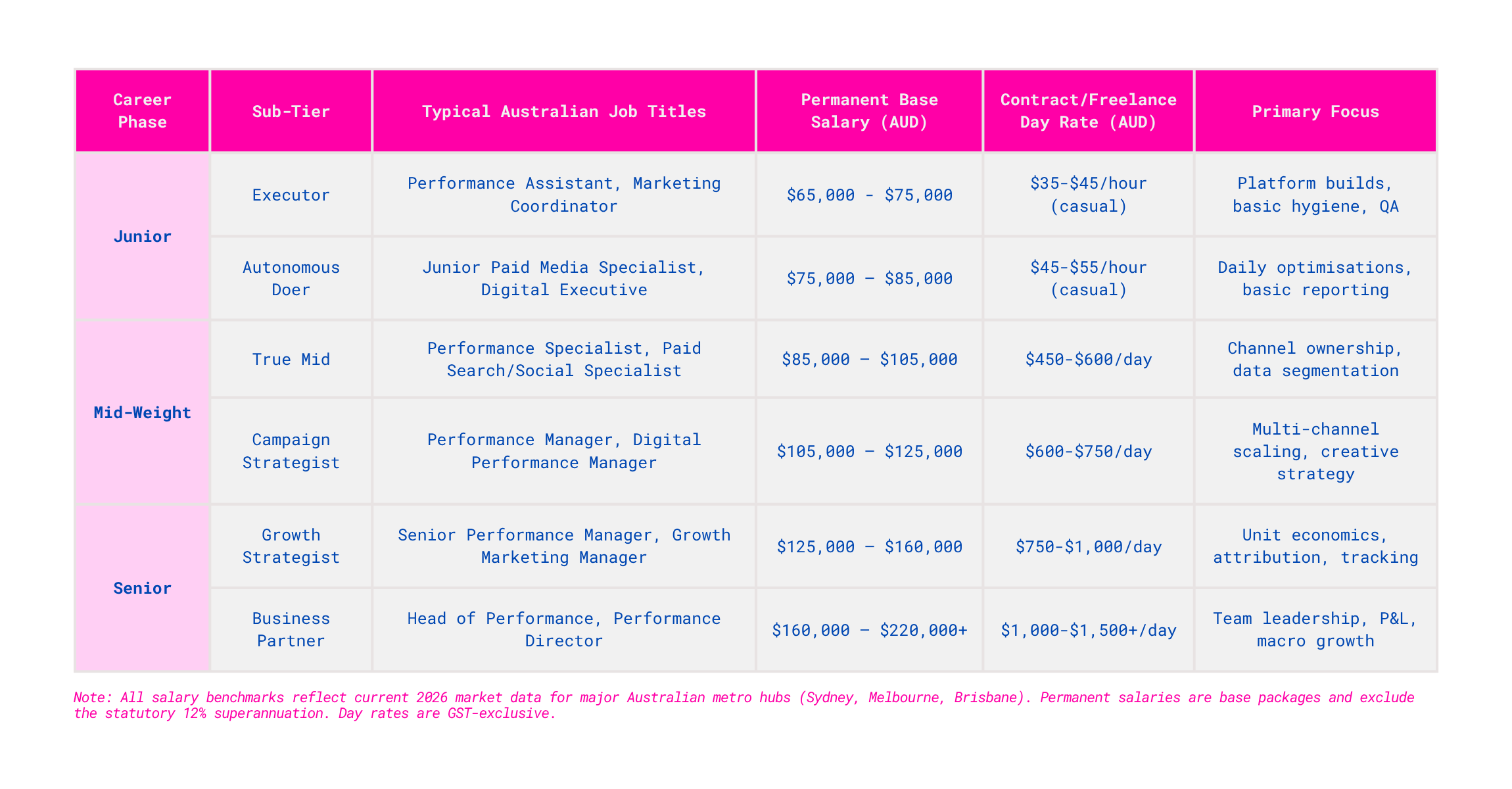
1. The Junior Spectrum: From Executor to Autonomous Doer
Junior talent is the operational engine room of any digital team. At this level, success isn’t measured by strategic vision, but by technical curiosity, speed, and attention to detail.
Tier A: Executor (True Junior)
Typically fresh graduates, career changers, or marketing assistants stepping into their first specialised role. They understand platform mechanics conceptually but haven’t managed budgets in-platform.
- Hard Skills: Navigating Meta Ads Manager and Events Manager or Google Ads UI, basic keyword research, pulling platform data into CSV files, and uploading creative assets.
- Hiring: This tier is almost exclusively a permanent play. It rarely makes sense to hire a freelance or contract true junior, as the training overhead requires heavy internal senior resources.
Tier B: Autonomous Doer (Advanced Junior)
They have 6 to 18 months of hands-on platform experience. The basic user interfaces no longer intimidate them, and they can manage low-to-mid risk campaign executions on their own.
- Hard Skills: Structuring standard creative tests, setting up custom audiences, writing baseline ad copy, and building clean client dashboards.
- Hiring: If you have an unexpected surge in client work or a permanent staff member departs, an Advanced Junior can occasionally be brought in on a temporary contract to handle the day-to-day administrative heavy lifting of campaign maintenance. For the most part, this would be a casual or permanent position.
Moving Up: A junior crosses the line into mid-weight territory when they stop asking “What do I do next?” and start asking “Why are we allocating budget to this campaign over that one?”
They should be very comfortable with reporting, setting up campaigns and troubleshooting basic issues in the platforms. Additionally, they should be focusing on how to improve hooks and visual assets.
2. The Mid-Weight Spectrum: From Optimiser to Campaign Strategist
The mid-weight tier is where most hiring mismatches happen because it spans a massive jump in skill and accountability.
Tier A: True Mid-Weight
A True Mid-Weight is usually a dedicated specialist. They are often a pure “Paid Social” or a “Paid Search” Specialist. They take a specific channel brief and handle it end-to-end without needing their hand held.
Many mid-weight’s will have experience across multiple platforms, but they’ll still usually lean towards social or search.
- Hard Skills: In-depth data analysis (Third Party Tracking, Looker Studio, Website Back-End), budget allocation adjustments, Creative Strategy, fatigue identification, and direct client or stakeholder communication.
- Hiring: Freelancers start working well here. If your agency brings on an e-com client and your current team lacks deep Meta capability, dropping in a specialist freelance True Mid-Weight allows you to scale up delivery immediately without committing to a permanent salary line while the account stabilises.
As for brand-side, this person will work really well alongside a Marketing Manager or Consultant that sets the overarching strategy, while this person jumps in to execute, analyse and optimise.
Tier B: Campaign Strategist (Senior Mid-Weight)
This is a critical transition role. This marketer is stepping out of a single-channel silo. They understand that a high-performing Meta campaign drives downstream search volume on Google, and they plan accordingly.
- Hard Skills: Multi-channel funnel mapping, foundational landing page Conversion Rate Optimisation (CRO), implementing server-side tracking (Meta CAPI, Google Enhanced Conversions), and managing more complex testing roadmaps. As well as high level Creative Strategy across multiple platforms.
- Hiring: This is a prime target for a permanent hire if you are a growing brand building an in-house team. They have the execution grit to build out your channels, but enough strategic awareness to help you map out your tech stack.
This is also a highly desirable freelance position that is hard to hire for. As most candidates at this level are in permanent roles, as opposed to branching out to take on freelance work.
3. The Senior Spectrum: From Growth Strategist to Visionary Leader
Senior talent is no longer judged by how many campaigns they launch or how clean their ad accounts look. They are judged entirely on business outcomes, bridging the gap between ad spend and financial spreadsheets.
Tier A: Growth Strategist (True Senior)
A True Senior views ad platforms simply as levers to execute a broader business strategy. They talk the language of business economics rather than platform metrics.
- Hard Skills: Advanced attribution modelling, cohort analysis, customer unit economics tracking ($LTV:CAC$ ratios), creative direction frameworks, and full-funnel media planning.
- Hiring: Contractors and freelancers are highly effective at this tier. If your business is navigating a complex tracking migration, or launching a new product line, a high-calibre contract Growth Strategist can build this out over 3 to 6 months, train your mid-weights, and then step away.
This is also a valuable permanent role for both agencies and brands looking to build out performance with a strong leader that can work across both strategy and execution as needed.
Tier B: Business Partner (Director-Ready Senior)
The absolute peak of the performance spectrum. They are leaders, people managers, and commercial operators who sync marketing directly with finance, product, and supply chains.
- Hard Skills: P&L management, cross-departmental alignment, agency/vendor procurement, predictive market forecasting, and high-level team leadership.
- Hiring: This requires a dedicated permanent leader to drive long-term organisational culture and growth strategy. However, if a Head of Performance/ Performance Director goes on parental or unexpected leave, a contractor at the same level is desirable to prevent performance drift.
This is also a great hire for brands with large marketing budgets and multiple platforms with heavy budgets that are essential to revenue. Your Performance Director will sit at the Executive level, informing key business decisions centred around performance data.
How to Apply This to Your Growth Strategy
When you look at your performance marketing function, don’t just look for a generic somebody. Look at where your current operational and strategic gaps lie on the spectrum.
- Need pure execution muscle to handle a temporary influx of client work? Secure a freelance True Mid-Weight.
- Need to build an internal growth engine from scratch for a funded scale-up? Hire a permanent Campaign Strategist or Growth Strategist. Or, hire a freelancer on a fixed term contract.
- Need someone to lead a team of 10 and own the commercial outcome of an entire brand? Invest in a permanent Visionary Leader.
Need help with hiring a performance marketer? Schedule a briefing with Brooke today at brooke@creativenatives.com.au. She’ll find the best talent to help your business.